Sindh University marks Youm-e-Istehsal Kashmir, calls for peaceful resolution of dispute
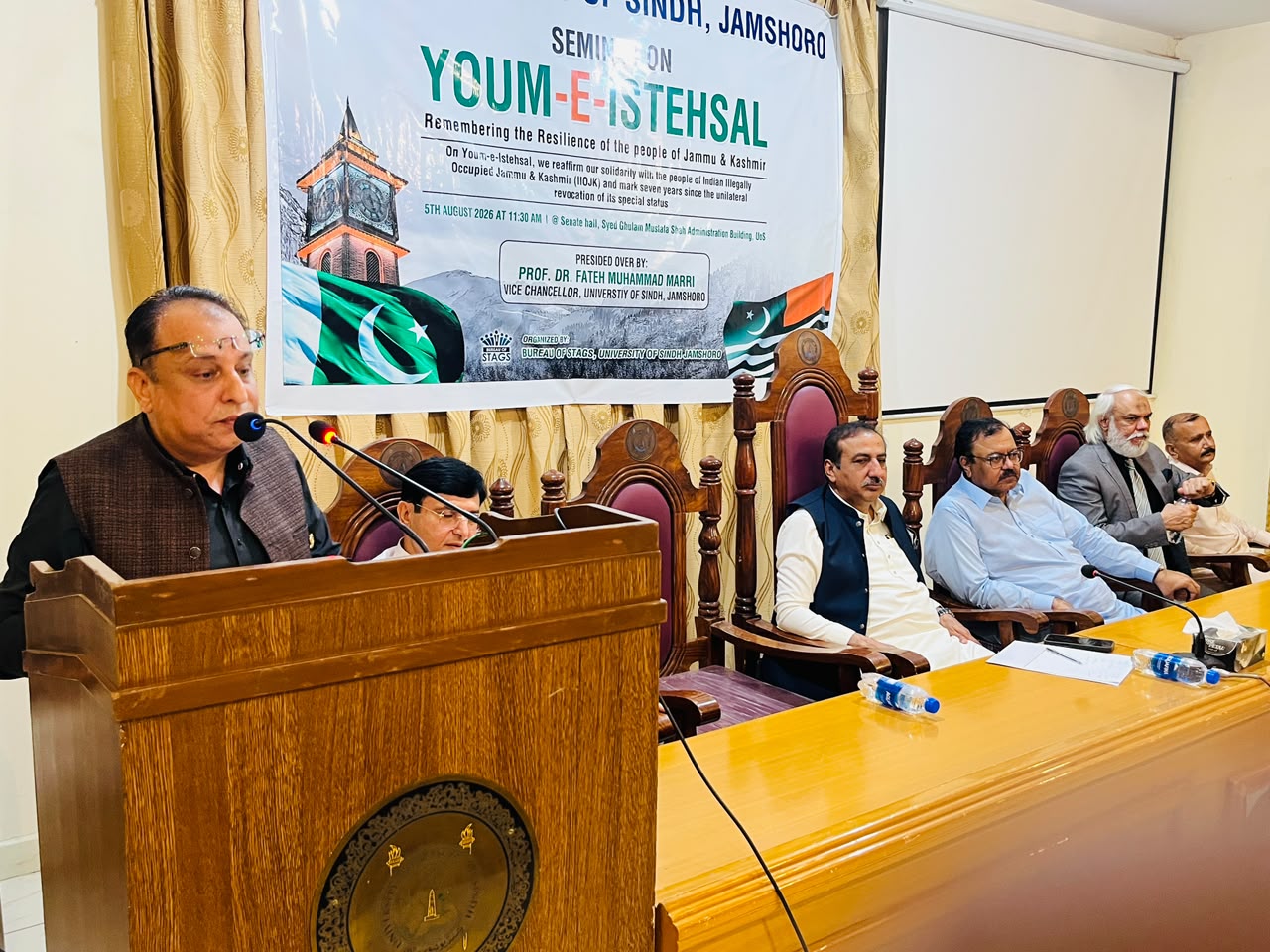
The University of Sindh observed Youm-e-Istehsal Kashmir on Wednesday with a seminar in which speakers reaffirmed support for the Kashmiri people's right to self-determination and condemned India's unilateral revocation of the special constitutional status of Jammu and Kashmir on August 5, 2019.
They stressed that a peaceful resolution of the longstanding dispute, in accordance with relevant United Nations Security Council resolutions, was essential for lasting peace and stability in South Asia.
The seminar was chaired by Sindh University Vice-Chancellor Professor Dr Fateh Muhammad Marri (TI). The former Vice-Chancellor of Mehran University of Engineering & Technology Professor Dr Muhammad Aslam Uqaili, Pro-Vice-Chancellor SU Main Campus Professor Dr Abdul Sattar Shah, Chairman of the Department of Political Science Professor Dr Ghulam Akbar Mahesar, Chairman of the Department of History Professor Dr Irfan Shaikh, Pakistan Study Centre faculty member Dr Muhammad Mashooque Ali Khuwaja, deans of various faculties, heads of academic departments, directors, faculty members and students were present on the occasion.
In his presidential address, Professor Dr Fateh Muhammad Marri said that on August 5, 2019, India unilaterally revoked the special constitutional status of Jammu and Kashmir, a move that, he said, had been rejected by people of Kashmir, Pakistan and many in the international community.
He said the South Asian Association for Regional Cooperation (SAARC) had remained largely inactive due to strained relations in the region, adding that the resulting lack of cooperation had adversely affected regional development and stability.
Referring to the South Asian University in New Delhi, he alleged that students from Pakistan and some other SAARC countries had faced restrictions, adding that such policies undermined regional cooperation.
Dr Marri also referred to the Sir Creek issue and said it remained one of the unresolved disputes between Pakistan and India. He added that the illegal occupation of Jammu & Kashmir by India continued to affect regional peace, cross-border interactions and broader bilateral relations.
He said international agreements, including the Indus Waters Treaty, should be honoured by India and not altered unilaterally.
Former Mehran University Vice-Chancellor Professor Dr Muhammad Aslam Uqaili said Youm-e-Istehsal Kashmir should serve as a reminder of the need for practical efforts to address the issue rather than symbolic observance alone.
He urged India to refrain from actions that, he said, undermined the internationally recognised disputed status of Jammu and Kashmir.
Dr Uqaili said India's actions of August 5, 2019, sought to alter the constitutional and political status of Indian Illegally Occupied Jammu and Kashmir, adding that these measures had intensified hardships for the people of the region.
Chairman of the Department of Political Science Professor Dr Ghulam Akbar Mahesar said Pakistan had adopted a political map depicting Jammu and Kashmir as a disputed territory and reiterated Pakistan's call for a peaceful resolution of the issue through dialogue and in accordance with the aspirations of the Kashmiri people and relevant UN Security Council resolutions.
He also urged the international community, particularly the United Nations, to play a more active role in facilitating a peaceful settlement of the dispute.
Chairman of the Department of History Professor Dr Irfan Shaikh said Pakistan would continue extending moral, diplomatic and political support to the Kashmiri people. He said awareness programmes marking Youm-e-Istehsal Kashmir aimed to inform the public about the events of August 5, 2019, and Pakistan's stated position on the issue.
Dr Muhammad Mashooque Ali Khuwaja said Youm-e-Istehsal Kashmir provided an opportunity to express solidarity with the people of Kashmir and to reiterate support for a peaceful resolution of the dispute in accordance with relevant international resolutions.
He said the revocation of Article 370 by the Indian government on August 5, 2019, fundamentally altered the constitutional status of the region by dividing the former state into two federally administered territories.
He maintained that the aspirations of the Kashmiri people, in line with the relevant UN Security Council resolutions, should remain central to any future settlement of the dispute.
At the outset of the seminar organized by the Bureau of STAGS, Mr Nazar Hussain Chandio recited some verses from the Holy Quran followed by the national anthem of Pakistan.
Announcements