Allama Kazi’s novel inspires critical thinking, spiritual reflection among Sindh University students
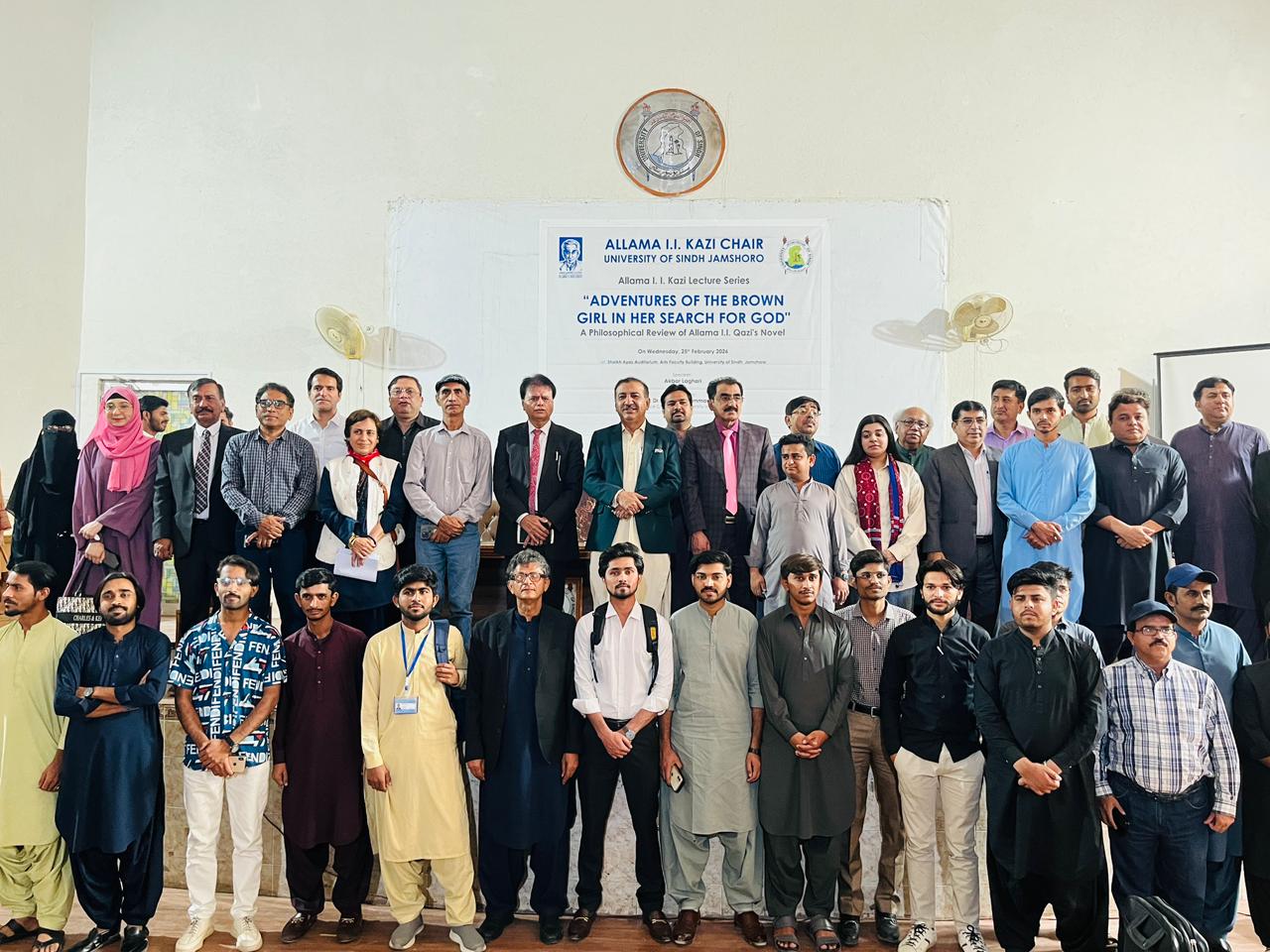
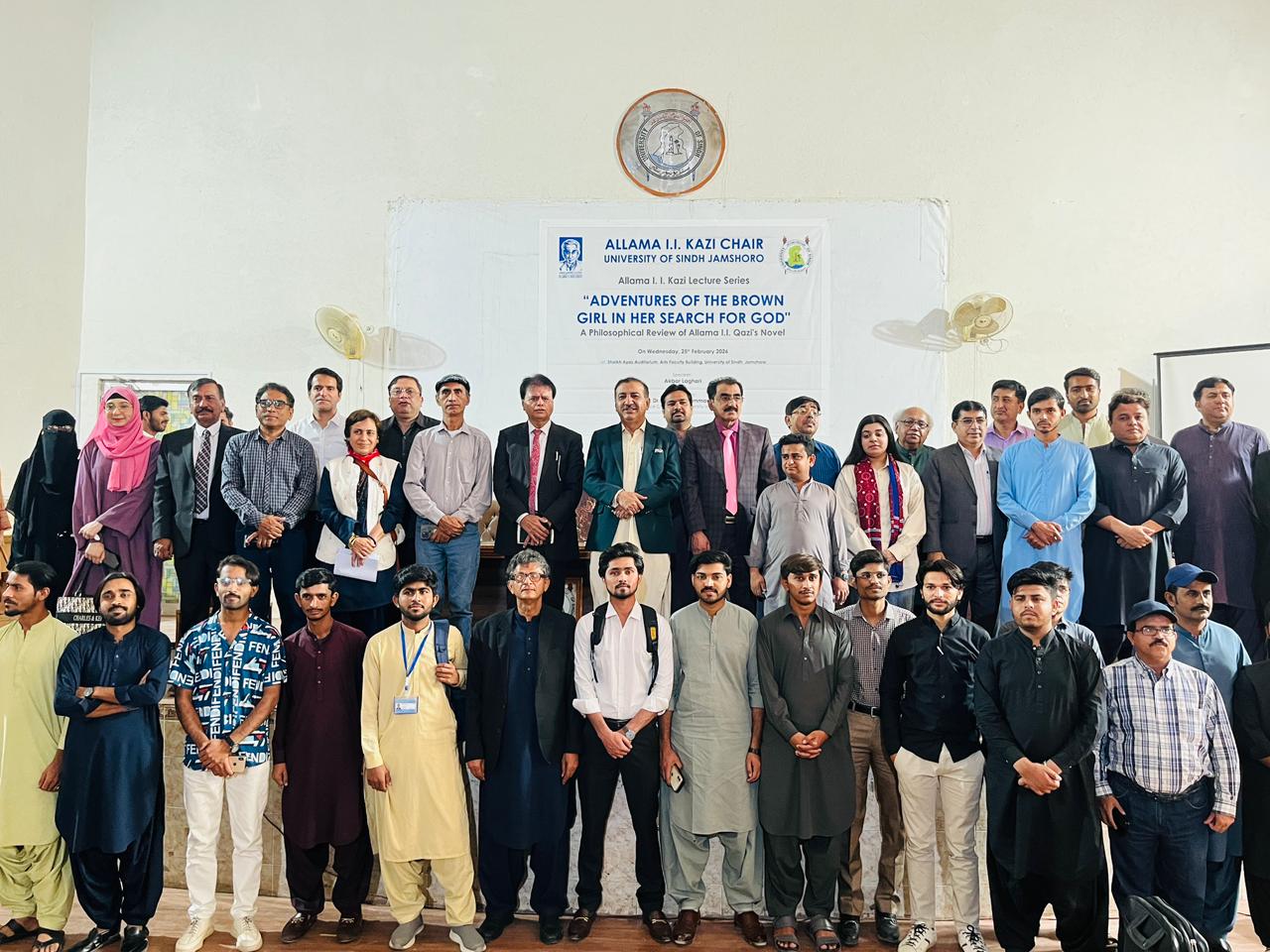
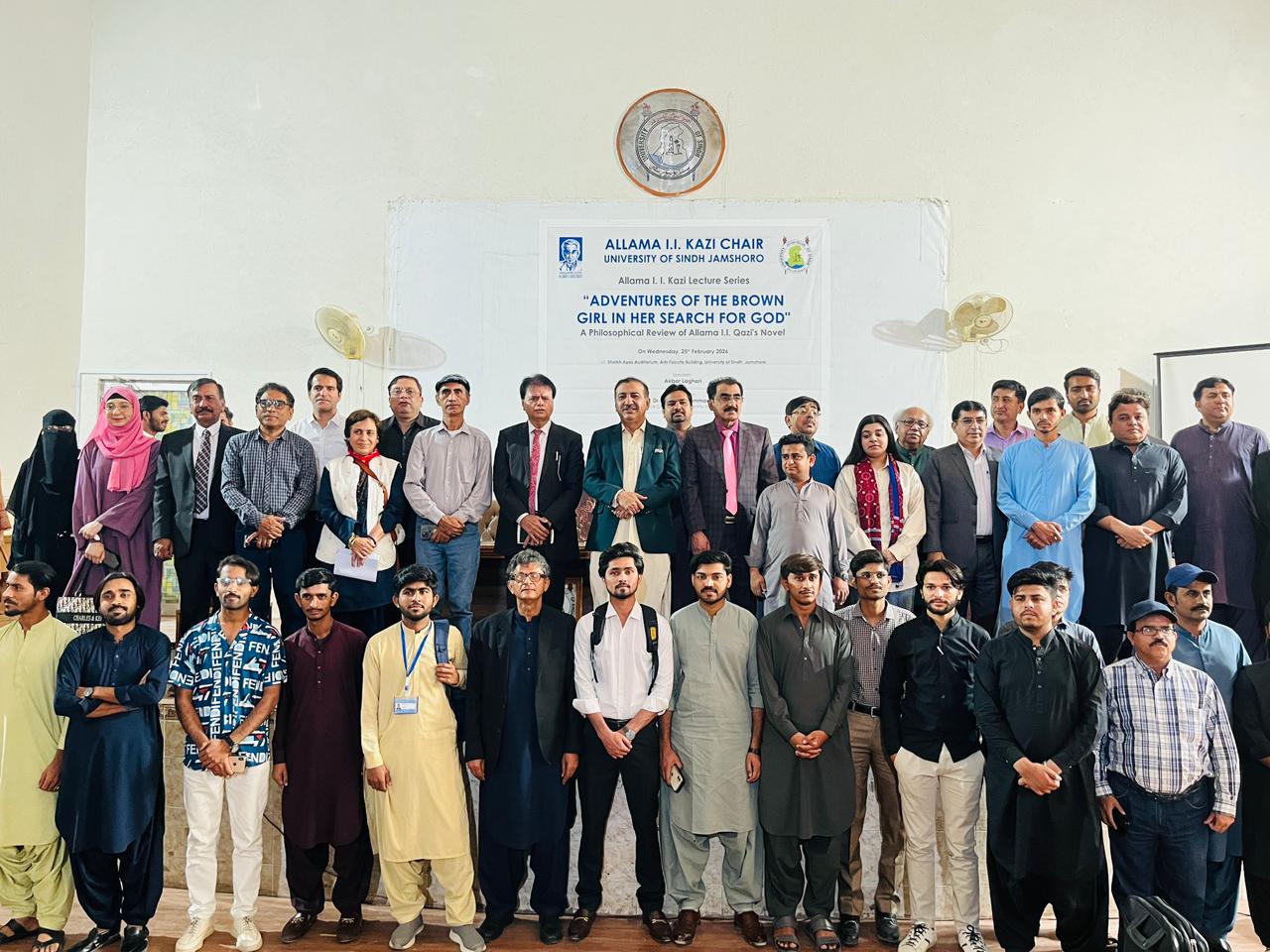
A comprehensive and scholarly lecture on the intellectual masterpiece novel of Allama I. I. Kazi, “Adventures of the Brown Girl in her Search of God” was organized by Allama I. I. Kazi Chair in the Sheikh Ayaz Auditorium of the Arts’ Faculty, University of Sindh, which was presided over by Vice-Chancellor Professor Dr. Fateh Muhammad Marri.
In his presidential address, Vice-Chancellor Professor Dr. Fateh Muhammad Marri said that Sindhi thought was a prime example of dialogic engagement with world literature.
He emphasized the importance of reading and understanding Allama Kazi’s novel in the modern era and said, “As even today, humanity continues to search for truth, peace and spiritual fulfillment”.
He added that the intellectual masterpiece “Adventures of the Brown Girl in her Search of God” will be republished in Sindhi and Urdu through the University’s Bureau of Translation and the Allama I. I. Kazi Chair and if need be, it could also be published again in English.
He remarked that such scholarly programs introduced the younger generation to the depth of thought and encouraged critical thinking.
He also expressed his satisfaction that students attended the entire lecture, engaged peacefully, and absorbed knowledge about the novel, urging them to listen attentively rather than leave midway.
At the event, former bureaucrat and researcher Akber Leghari delivered a detailed lecture highlighting both the literary significance and the philosophical and spiritual aspects of the novel.
He stated that Allama I. I. Kazi’s novel was written as a response to the Irish thinker George Bernard Shaw’s work “The Adventures of the Black Girl in Her Search for God” in 1931, yet its scope was much broader and deeper.
“Where Bernard Shaw critically examined Western religious ideas, Allama Kazi grounded the search for God in Eastern spirituality and Islamic thought and presented it in a constructive and positive manner,” he said.
Akber Leghari further explained that the character of the “Brown Girl” symbolized humanity itself, embarking on a journey questioning the meaning of existence, the reality of God and the purpose of life.
He noted that the novel reflected elements of existentialism, Sufism, monotheism and moral philosophy. He said that Allama Kazi tried to reconcile the tension between reason and faith, showing that reason was not denied but harmonized with spirituality.
He added that the search for God was not limited to logical discourse but also related to human conscience, intuition and moral awareness.
Leghari said that the novel served as a bridge between Eastern and Western thought. He explained that Allama Kazi engaged with the questions raised by Western philosophy and sought their answers within the framework of Eastern Sufi traditions.
The novel, he said, conveyed messages of unity of existence, human equality and global fraternity, which were highly relevant in today’s world.
He also stressed the importance of moral philosophy in the novel and said that the search for God was not merely metaphysical but connected to practical human life.
“Justice, love, truth and humanity are central values of the novel and the true understanding of God manifests in human character and actions,” he maintained.
The speaker concluded that “Adventures of the Brown Girl in her Search for God” was not just a literary masterpiece but also a source of philosophical and spiritual reflection, encouraging readers to confront the truth of their own existence.
He urged that the novel should be republished in Sindhi and Urdu and included in scholarly discussions to familiarize young people with the confluence of Eastern and Western thought.
“Allama I. I. Kazi’s novel is, in essence, a dialogue and intellectual continuation of George Bernard Shaw’s “The Adventures of the Black Girl in Her Search for God,” Leghari said and added that while Shaw approached Western religious ideas with critique and satire, Allama Kazi integrated Eastern spirituality, Islamic thought and Sufi traditions, presenting a constructive exploration.
He highlighted that the character of the “Brown Girl” symbolically represented the East, embarking on a quest for God while confronting different religious perspectives, philosophical arguments and schools of thought.
He emphasized that the novel balanced human reason, faith, intuition and spirituality, while it encouraged readers to engage in a thoughtful and ethical quest for God beyond mere ritual.
The lecture concluded with a question-and-answer session, during which students asked numerous philosophical and intellectual questions, all of which were answered in detail.
Incharge Dean faculty of Arts Dr. Muhammad Khan Sangi, Dean Faculty of Social Science Professor Dr. Nank Ram, the host of the event and Director Allama I. I. Kazi Chair Dr. Rushdullah Shah alias Makhmoor Bukhari, senior journalist & intellectual Niaz Panhwar, Dr. Arfana Mallah, Jamaluddin, Raja Altaf, Mehboob Leghari, Dr Zulfiqar Ali Leghari, Dr. Anwar Hussain, Dr. Abdul Hameed Panhwar, Dr. Sujomal, Dr. Mubarak Ali Lashari, Dr. Tariq Hassan Umrani, Dr. Sanaullah Ansari, Dr. Shazia Pitafi, Dr. Rehana Mallah, Amar Sindhu, Dr. Wazir Ali Baloch, Fahmida Narai, Asmat Khilji, Husamuddin Mirani, Dr. Sikandar Ali Soomro, Dr. Ahmed Ali Brohi, Dr. Shah Murad Chandio and Munir Chandio and others were also present on the occasion.
Announcements